Madrid enforces a low-emission zone with automatic number plate cameras, and its timetable has been adjusted more than once in recent years. For most visitors this changes nothing, because most visitors sensibly use the metro. For anyone hiring a car for day trips, or driving into Spain from France, Portugal, Germany or further afield, it matters a great deal, and the way it is usually explained in English is wrong in one specific and expensive way.
The split is by vehicle origin, not by nationality
Start here, because almost everything else follows from it.
The Madrid ZBE rules are set by Spanish national and municipal law, and they apply identically to every driver regardless of passport. There is no EU versus non-EU split, no different treatment for British or American or Australian drivers, and nothing about your citizenship changes what you are allowed to do. If you have read otherwise, that source has invented a distinction that does not exist.
What does determine your position is where the vehicle is registered:
- A car registered in Spain, which includes essentially every hire car collected in the country, is automatically assigned a DGT environmental category by the national traffic authority. The classification exists whether or not anyone has stuck the label on the windscreen.
- A car registered abroad cannot be issued a Spanish DGT sticker at all. The scheme has no mechanism to grant one to a foreign plate, so the vehicle has to be handled through a separate registration route with the city.
A French citizen in a Spanish hire car and an Australian in the same car are in exactly the same position. A Spanish citizen driving in on German plates faces the foreign vehicle process like anyone else.
If you hired the car in Spain
This is the easy case, and it covers the large majority of readers heading out on day trips from Madrid.
Spanish rental fleets are modern, and their cars almost always carry a C, ECO or CERO classification, all of which are permitted to circulate throughout Madrid, including the central zones. In practice you can collect the car and drive without doing anything further.
Two things are still worth doing. Ask at the desk which environmental label the specific car carries, which takes ten seconds and removes all doubt if you intend to drive into the centre. And ask how the company handles a camera penalty issued after you have returned the vehicle, since fines arrive by post to the registered keeper and rental companies pass them on, usually with an administrative charge attached.
If you are driving a foreign-plated car into Madrid
This is where people get caught. Because no Spanish sticker can be issued for your plate, Madrid runs a separate authorisation process for foreign registered vehicles: you submit the vehicle documentation and its emissions details to the city, and your plate is assessed against the equivalent Spanish category and registered in the system so the cameras recognise it.
Three practical points. First, start early. Reported lead times for the foreign vehicle process run to several weeks, and it is not something to attempt from a motorway service station the day before. Second, the assessment is based on the vehicle’s emissions standard, so an older diesel or petrol car may not qualify at all, in which case no amount of paperwork opens the central zones to it. Third, several countries operate their own environmental sticker schemes, and holding one of those does not automatically substitute for Spanish registration, though it can help evidence your vehicle’s classification during the process.
Apply through the official Ayuntamiento de Madrid channels. There are commercial sites that will complete the same registration for a fee, and there is no reason to use them. Confirm the current route and requirements on madrid.es before you travel, because the procedure has been adjusted more than once.
Hire the car in Spain and skip the paperworkA Spanish registered rental already carries its DGT environmental categoryThe zones are not one zone, and where 2026 leaves them
Madrid does not have a single boundary, and conflating the layers is a reliable way to get a fine.
There is a city-wide ZBE covering the whole municipality, which is the layer that keeps unlabelled vehicles out. Inside it sit stricter central sub-zones, including the former Madrid Central area, now designated as the special protection zone for the Centro district, and a further zone around Plaza Elíptica. These central areas apply tighter rules and restrict categories that are perfectly legal elsewhere in the city.
The important implication: being allowed to drive in Madrid does not mean being allowed to drive into the middle of it. Use the official city map to check the specific streets you intend to use rather than assuming a single perimeter, and note that access to the central zones can also depend on your reason for entering, for example driving directly to a car park inside the zone or being a registered resident’s guest.
What 2026 did and did not change
A lot of what is written about 1 January 2026 gets this backwards. No new city-wide ban took effect that day for visitors. A vehicle with no environmental label at all that is not registered in Madrid was already barred from the city’s urban roads under the earlier phases of the scheme, so for an older car driven in from elsewhere in Spain or from abroad, the position in 2026 is the same as before. This is the oldest end of the fleet and it is unlikely to affect a hire car, but it can affect an older private vehicle.
The ban that had been scheduled for unlabelled cars registered in Madrid itself, owned by residents who pay the city’s vehicle tax, was postponed again, and at the time of writing those residents can still drive them outside the strictest central zones. That is a local residents’ rule. It does not cover a hire car, a car registered elsewhere in Spain or a foreign plate.
The central sub-zones are stricter again: vehicles with the B label, the lowest labelled category, are excluded from them while remaining free to circulate across the rest of the city, with access to the centre depending on a qualifying reason such as parking in a car park inside the zone.
Coverage of these changes in aggregator articles is inconsistent, and some of it is simply out of date. Verify the current position against the DGT and the Ayuntamiento de Madrid before you rely on it.
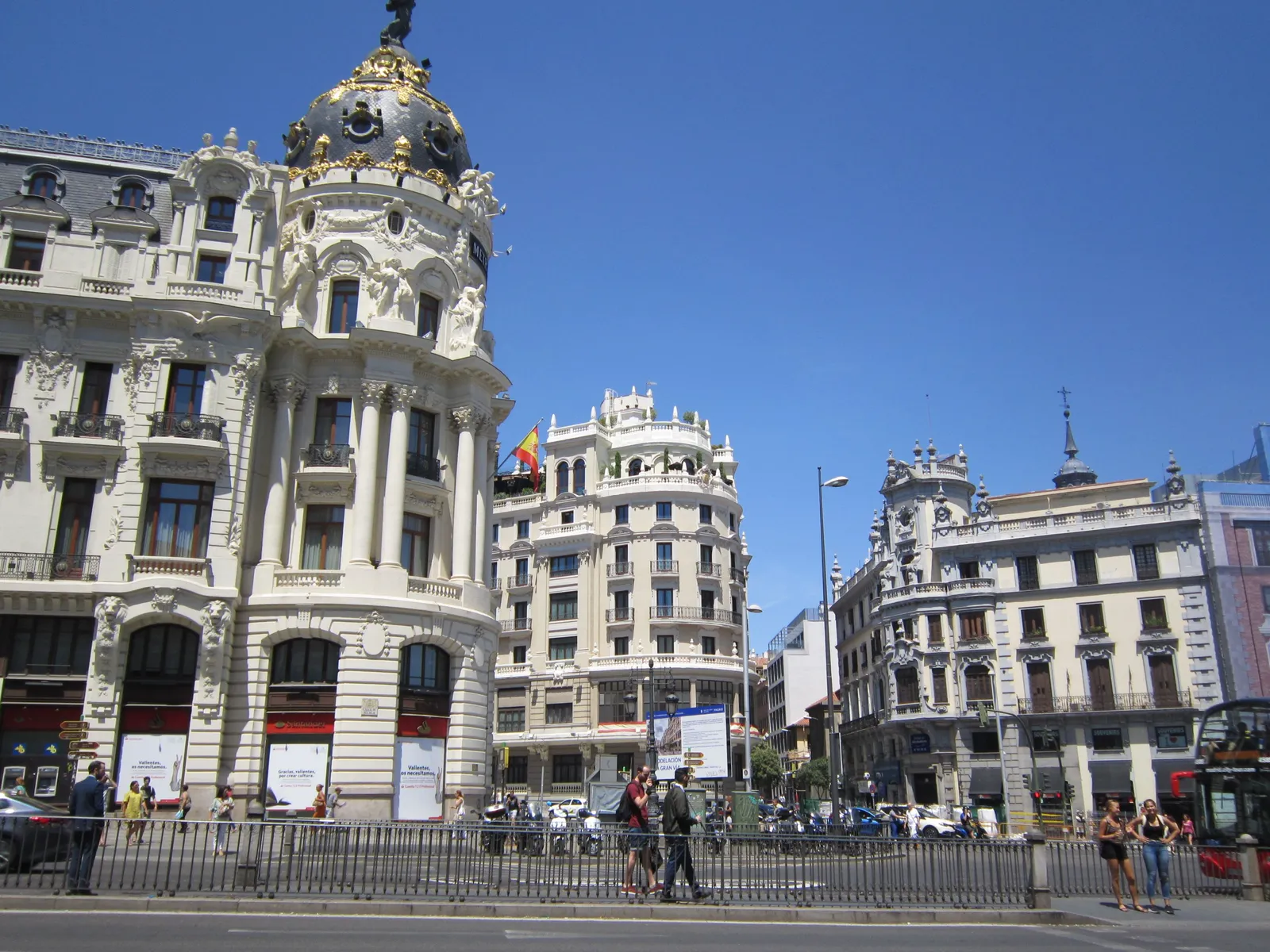
Fines, exemptions and hotel guests
Enforcement is automatic. Cameras read plates at the zone boundaries, there is no roadside stop and no warning at the moment of entry, and the first you know about it is a notice arriving weeks later.
The penalty for entering in breach is widely reported at 200 euro, and Spanish traffic fines are commonly reduced for prompt payment within a window stated on the notice. Both the amount and the discount period are set by municipal ordinance and can change, so treat those as indicative and confirm with the Ayuntamiento.
Exemptions exist and are narrower than people hope. Vehicles displaying a recognised disabled badge, emergency and certain service vehicles, and specific registered categories are treated differently. Hotel guests are a genuine case: staying at an establishment inside a restricted zone can allow authorised access, but it normally requires the hotel to register your plate in advance rather than you simply arriving. If your accommodation is in the Centro district and you are driving, contact them before you travel and ask them to register the vehicle. Do not assume a booking confirmation is sufficient.
The honest recommendation
For a city trip, do not hire a car. Madrid’s metro is fast, cheap and comprehensive, as our guide to getting around Madrid sets out, and parking in the centre is expensive and heavily restricted before any of the emission rules come into play. Nearly everything a first time visitor wants is covered in our first time in Madrid guide without a vehicle appearing once.
If you do want a car for a rural loop or for towns the train does not reach well, the clean solution is to collect it from an airport or peripheral office on the way out and return it the same way, so the car never enters the restricted centre at all. And if you are driving your own foreign plated car into Spain, sort the registration weeks ahead rather than discovering the problem at the boundary.